

We are used to AI agents recommending products, comparing prices, and answering shopping questions. But what happens when an agent can also select the right item, apply the customer’s preferences, authorize payment, and place the order without a person clicking “Buy”?
That future is already taking shape in 2026. Agentic commerce moves AI from product discovery into transaction execution. The question for enterprise ecommerce leaders is no longer whether AI agents will influence sales. It is whether your store is ready to accept an order that no human directly confirmed at the final moment.
1. The next wave: from recommendations to transactions
Traditional ecommerce gives customers control at every step. A shopper visits a website, adds products to a cart, enters payment details, and confirms the purchase.
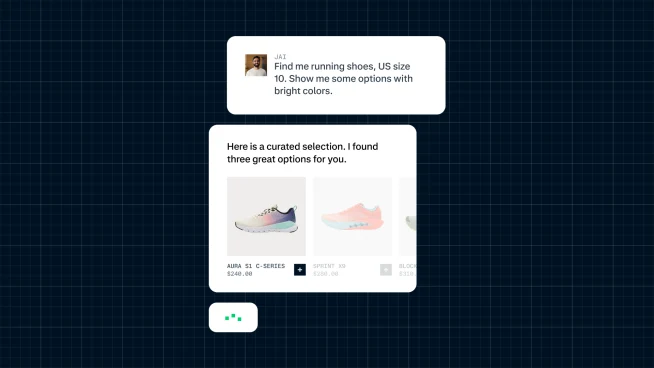
Ecommerce AI agents change this flow. A customer may say, “Find me a waterproof business jacket under $300 and order it if the size and delivery date match my preferences.” The agent can search products, evaluate options, build a cart, and complete the purchase within approved limits.
This is the practical meaning of agentic checkout. The customer still sets the intent and permissions, but the agent manages more of the work. Shopping becomes easier, faster, and more personalized across search, chat, assistants, and other digital surfaces.
2. What agentic checkout actually means
Agentic checkout is not simply a chatbot connected to a payment button. A reliable purchase needs four essential components.

1. A machine-readable catalogue
The agent needs structured information that it can understand and compare. This includes product attributes, variant-level availability, current pricing, delivery options, taxes, promotions, and return terms.
A product feed that looks acceptable to a human may not be complete enough for an agent. If the feed does not clearly distinguish colours, sizes, stock levels, or delivery dates, the agent may present the wrong offer or create an order that cannot be fulfilled.
2. A way to prove the automated client is legitimate
Your systems must distinguish an approved shopping agent from a scraper, fraud bot, or automated attack. This requires controls such as allowlisting, request signing, authenticated APIs, and clear agent identity signals.
The goal is not to block automation. The goal is to welcome trusted automation while protecting pricing, inventory, customer data, and checkout infrastructure.
3. A delegated mandate to spend
A customer needs a safe way to authorize an agent to act within defined boundaries. A mandate may include a maximum amount, permitted merchants, product categories, delivery requirements, expiry time, and whether the authorization applies once or repeatedly.
This gives the agent useful freedom without giving it unlimited purchasing power.
4. A record of who authorized what
Every agent-led order needs a defensible audit trail. The merchant should be able to identify the mandate, agent, customer intent, offer shown, checkout data, payment authorization, and confirmation returned.
If your system keeps only an order number and a payment record, it may be difficult to explain what the customer authorized during a later refund request or chargeback.
3. What shipped in 2026
The market is moving quickly, but it is not moving in one direction. Several major companies are building different parts of the agentic commerce stack.
Google introduced the Universal Commerce Protocol (UCP) on January 11, 2026. UCP creates a common language between AI agents, retailers, commerce systems, and payment providers. It is designed to support discovery, buying, and post-purchase support rather than only the payment step.
Google also announced Universal Cart on May 19, 2026. The concept allows shoppers to collect products from multiple retailers and complete purchases through saved payment methods or transfer the cart to a merchant website.
OpenAI and Stripe are developing the Agentic Commerce Protocol, which supports “Buy it in ChatGPT” experiences. OpenAI’s commerce documentation explains that merchants continue to validate orders, calculate taxes, assess risk, charge the payment method, and decide whether to accept the purchase.
Google’s Agent Payments Protocol focuses on secure agent-led payments. It is designed to connect user intent, cart details, and payment credentials through verifiable authorization.
Adyen entered the market with Adyen Agentic on June 16, 2026. Its three layers are:
- Agentic Feed: Real-time product, price, and inventory data.
- Agentic Cart: Connections to checkout, tax, fulfilment, and order systems.
- Agentic Payments: Authentication, token portability, fraud controls, and merchant-of-record support.
These developments point to an important conclusion: enterprises should prepare for multiple agentic channels instead of betting everything on one platform.
4. The delegated mandate: how payment authorization works
The biggest change is that payment approval may happen before the final purchase event.
In a delegated mandate model, the customer authenticates once and gives the agent defined authority. The mandate can specify:
- Maximum spend
- Approved merchant or merchant group
- Product or category restrictions
- Validity period
- One-time or recurring use
- Shipping or delivery conditions
The agent presents that mandate when it creates the order. The merchant receives the request as an agent-initiated transaction and validates the mandate before charging the customer.
This approach also changes the role of strong customer authentication. Under frameworks such as PSD2, authentication may move toward the moment the mandate is issued rather than appearing during every later purchase. That can create a smoother customer experience, but only when the authorization is clear, limited, and traceable.
Payment credentials should remain protected through tokens or delegated payment instruments. For example, OpenAI’s Delegated Payment Spec uses a one-time payment request with a maximum chargeable amount and an expiry. The agent does not need access to raw card details.
However, secure payment does not remove merchant responsibility. Enterprises still need clear rules for fraud review, refunds, fulfilment failures, and disputed transactions.
5. The three protocol families and what they mean for merchants
The emerging protocol families overlap, but they do not work in exactly the same way.
| Protocol family | Primary role | Where checkout may happen | Payment credential approach |
|---|---|---|---|
| OpenAI ACP | Agent-led discovery and checkout in experiences such as ChatGPT | Inside the AI experience, using merchant checkout systems behind the scenes | Delegated or tokenized payment details handled by the merchant or PSP |
| Google UCP + AP2 | Common commerce language plus secure agent payments | Google AI surfaces, merchant sites, or other compatible experiences | Mandates and payment authorization designed for agent-led transactions |
| Platform or payment-layer integrations | Translation and orchestration across multiple agent channels | Depends on the connected AI platform and merchant architecture | Tokenized credentials, authentication, fraud screening, and PSP controls |
The critical question is not only who holds the payment credential. It is also who controls the checkout state, who remains the seller or merchant of record, and who carries the loss when an order is disputed.
Public announcements provide useful direction, but they do not yet settle every commercial and legal question. Enterprises should ask protocol providers and payment partners:
- Who handles an unauthorized agent order?
- What evidence is available during a chargeback?
- Which party controls the refund decision?
- How are customer mandates revoked?
- What happens when the agent uses outdated price or inventory data?
There is also no independent, broad adoption or accuracy data that proves how reliably agents will interpret complex product information at scale. Enterprise pilots should measure these outcomes rather than assuming that protocol support guarantees performance.

6. What enterprises must prepare now
The good news is that most preparation is protocol-independent. These improvements strengthen your ecommerce operation whether UCP, ACP, AP2, or another standard becomes dominant.
1. Build a machine-readable product catalogue
Expose product information at the variant level. Include real-time stock, total landed cost, taxes, delivery date, subscription terms, and the return window in days.
Your catalogue should answer the questions a customer would ask before buying. Our earlier guide on catalogue quality and ecommerce conversion explains why accurate product data is becoming a core growth asset.
2. Refresh data continuously
Agents should order against current price and inventory data, not overnight feeds. A delay of several hours can create overselling, incorrect discounts, or delivery promises your operations team cannot keep.
Connect your product information, inventory, pricing, fulfilment, and order management systems so the agent receives one reliable commercial view.
3. Separate legitimate agents from harmful bots
Use allowlisting, authenticated requests, request signing, rate limits, and monitoring. Create a clear policy for approved agents and document what each one can access.
Your bot mitigation strategy should protect your business without treating every automated client as hostile.
4. Prepare chargeback evidence
Retain the mandate reference, mandate scope, expiry, agent identity, product and offer data shown, checkout values, payment authorization, confirmation returned, and fulfilment events.
This evidence helps your team investigate disputes and demonstrate how the transaction was authorized. It also creates accountability when several platforms participate in one purchase.
5. Design for human escalation
Some purchases will still need customer input. A furniture order may require a delivery slot. A luxury product may need identity verification. A regulated product may require additional consent.
Your commerce architecture should let agents pause, ask for the missing information, and continue without restarting the entire checkout.
7. How Edreamz helps enterprises become agent-ready
Agentic commerce will reward businesses with strong commerce foundations. Edreamz helps enterprise brands create those foundations across Shopify Plus, BigCommerce, custom applications, and CMS platforms.
Our team can help you build machine-readable catalog architectures, improve structured JSON-LD data, connect real-time inventory and pricing, and prepare commerce APIs for evolving standards such as UCP and AP2.
As a Shopify development company and experienced Shopify Plus agency, we can extend your store without disrupting existing customer journeys. We also provide BigCommerce development services for brands that need flexible, scalable enterprise ecommerce solutions.
Our offshore engineering team in India delivers secure integrations, structured data systems, bot-mitigation-aware edge setups, payment connections, and ongoing support. We help you prepare for agentic commerce while keeping your existing business logic, customer relationships, and operational controls in place.
Agentic checkout is still developing, but the direction is clear. AI agents will increasingly help customers move from intent to purchase with less friction. Brands that invest now in accurate data, secure authorization, reliable integrations, and strong evidence will be ready to participate with confidence.
Is your ecommerce platform ready to accept the next generation of orders? Talk to Edreamz Technologies and start building an easier, faster, and more secure agent-ready commerce experience today!