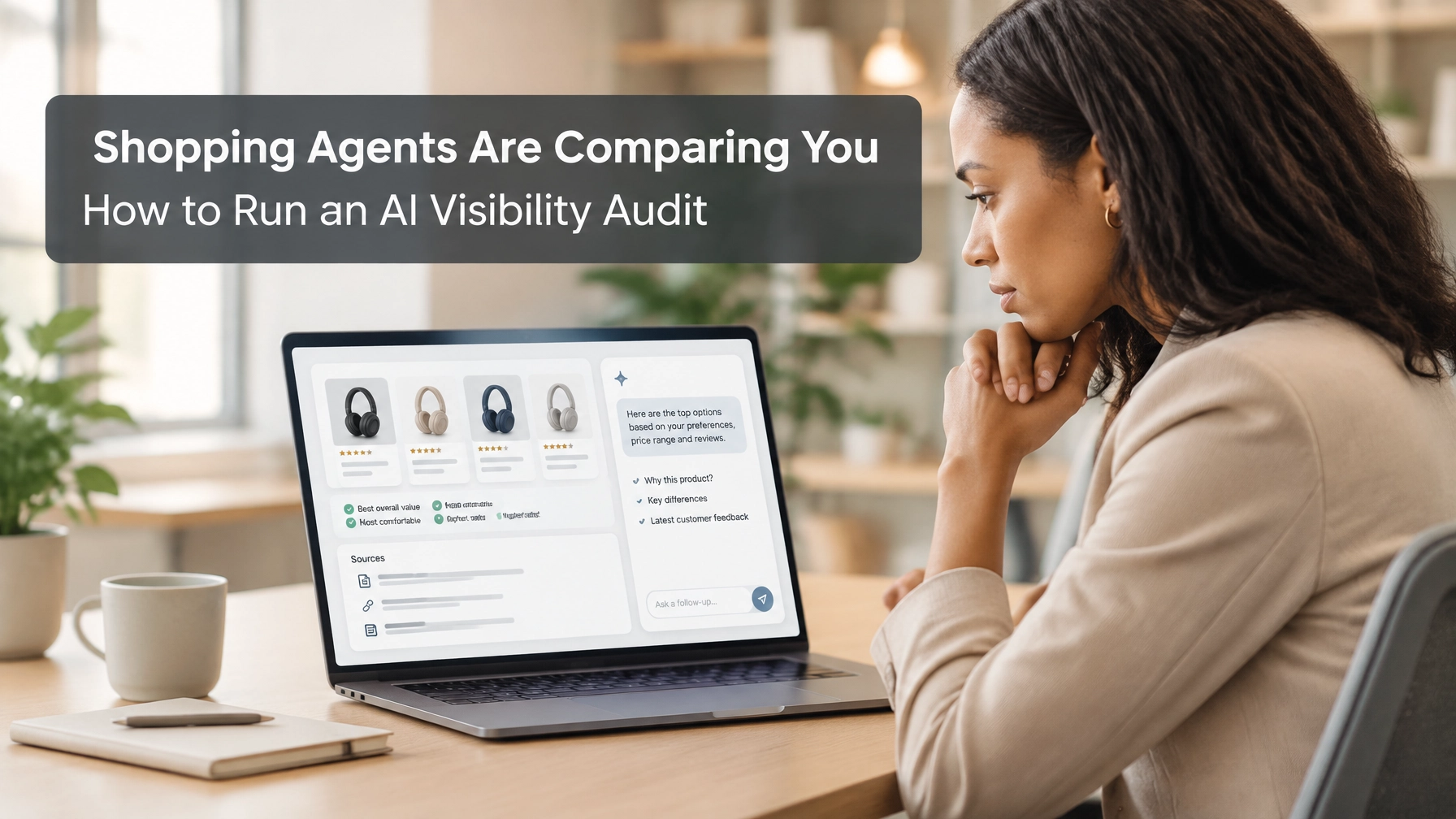
Do you know what ChatGPT says when someone asks, “Which brand should I buy from?” A shortlist is being formed every day across ChatGPT, Gemini, Perplexity, Google AI Overviews, and Copilot. Your brand may be recommended, left out, or described incorrectly, often without anyone on your team knowing.
This is the new reality of agentic commerce, where AI systems help shoppers discover, compare, and sometimes purchase products. The good news is that you can measure your visibility, identify gaps, and improve how these systems understand your business.
1. Why AI visibility is different from SEO
Traditional SEO focuses on ranking pages in search results. Generative Engine Optimization (GEO) focuses on helping AI systems understand and recommend your brand. Answer Engine Optimization (AEO) has a similar goal: making your content clear and useful when an AI generates a direct answer.
You are no longer competing only for position one. You are competing to be:
- Included in the shortlist.
- Recommended as a suitable choice.
- Described accurately.
- Cited as a trustworthy source.
Google’s Universal Commerce Protocol announcement shows how conversational shopping is moving toward product discovery, checkout, and post-purchase support. Microsoft is also developing Brand Agents and Copilot Checkout, as described in its retail AI announcement.
This creates a new commercial channel. AI-referred visitors often arrive after asking for a comparison or recommendation, so they can show stronger purchase intent than broad, early-stage traffic. Your own analytics should confirm the difference.

2. The three ways your brand can appear
Every AI answer gives you useful information. In practice, your brand usually appears in one of three ways:
-
Recommended and accurate: the win
The agent includes your brand, explains why it fits the shopper’s needs, and uses correct information about price, products, shipping, and returns.
-
Absent: invisible at the moment of comparison
The shopper asks for the best option, but your competitors make the shortlist. You may still rank well in Google, yet remain missing from the answer that influences the final decision.
-
Present but wrong, actively harmful
An agent may say that your brand offers free returns when it does not, show an outdated price, list a discontinued product, or describe an incorrect delivery window. A confident mistake can create a disappointed customer before the customer ever visits your website.
This is why ecommerce AI agents require more than brand awareness. They need accurate, current, and clearly structured information.
3. Step 1: Build a buyer-intent prompt set
Start with 25–50 prompts that reflect real customer questions. Do not write prompts only for keywords. Use questions from sales calls, support tickets, product reviews, onsite search, and conversations with your retail teams.
Include four categories:
- Category and use-case prompts: “What is the best skincare brand for sensitive skin?”
- Comparison prompts: “Brand A vs. Brand B for long-term durability.”
- Best-for prompts: “What is the best travel backpack under $200?”
- Trust and post-purchase prompts: “Is Brand X reliable for returns?” or “Does Brand X deliver quickly?”
Add brand-specific questions such as:
- “Is Brand X any good?”
- “What are the main alternatives to Brand X?”
- “Which brand has the clearest warranty?”
- “Which retailer has this product in stock and can deliver this week?”
Use the language customers already use. A prompt that sounds like a real buying question will produce more useful findings than a prompt written only to include a target keyword.
4. Step 2: Run the audit consistently
Run every prompt across the engines that matter to your customers:
- ChatGPT with web browsing enabled.
- Perplexity.
- Gemini.
- Google AI Overviews.
- Copilot, where relevant to your market.
Always use a fresh session. Conversation history can influence the answer and contaminate your results. Record the date, country or location, browser context, model name, and model version whenever the platform provides it.
Take screenshots as evidence. AI answers change between model releases, data refreshes, and even separate sessions, so you should treat each audit as a recorded observation rather than a permanently reproducible search result.
5. Step 3: Log five fields for every result
For every prompt and engine combination, record these five fields:
- Mentioned: Did the answer include your brand at all?
- Recommended: Did the agent actively choose or recommend you?
- Cited: Did it link to your domain as a source?
- Position: Where did you appear in the recommendation order?
- Accuracy and sentiment: Was the information correct, current, and positive?
Use this copy-ready table:
| Prompt | Engine and model version | Mentioned? | Recommended? | Cited domain | Position | Accuracy or sentiment notes | Date and screenshot |
|---|---|---|---|---|---|---|---|
| Best product for [use case] | ChatGPT / version | Yes/No | Yes/No | example.com | 1–5 | Price correct; shipping outdated | Date / link |
| Is [brand] reliable for returns? | Perplexity / version | Yes/No | Yes/No | example.com | 1–5 | Return window incorrect | Date / link |
A simple spreadsheet is enough to begin. You do not need an expensive platform before you understand your baseline.

6. Step 4: Calculate the metrics that matter
Turn the results into three headline metrics:
- Mention rate: Prompts where your brand appeared ÷ total prompts.
- Recommendation rate: Prompts where your brand was actively recommended ÷ total prompts.
- Citation rate: Prompts where your domain was cited ÷ total prompts.
Also track share of voice against a defined competitor set. If your brand appears in 20% of relevant answers and your three named competitors appear in 45%, 38%, and 27%, you have a clear view of the competitive gap.
Prioritize the metrics in this order:
- Recommendation rate shows whether agents consider you a suitable choice.
- Accuracy shows whether that recommendation can create a good customer experience.
- Citation rate shows whether your own content supports the answer.
- Mention rate shows general visibility.
Citation analysis deserves special attention. Identify whether agents rely on product pages, comparison articles, review websites, forums, marketplace listings, or your documentation. A brand may be mentioned often but cited rarely, which means another website is shaping the customer’s understanding.
7. Step 5: Diagnose why you are losing
Group every problem into one of three areas:
- Data problems: Missing structured data, thin specifications, inconsistent variants, absent GTINs, stale pricing, or unclear inventory.
- Content problems: No useful comparison pages, weak buying guides, unclear FAQs, or incomplete shipping and returns documentation.
- Authority problems: Your brand is missing from the review sites, listicles, forums, and industry sources that AI engines regularly cite.
For each prompt where a competitor appears and you do not, ask:
- Which source did the engine cite?
- Did that source contain information we do not publish?
- Is the competitor easier to compare because its product data is clearer?
- Can we create a better page or earn a credible mention on that source?
Agents compare structured facts such as price, availability, shipping certainty, return clarity, ratings, and product compatibility. Strong brand storytelling still matters, but it cannot replace clear information that an agent can safely use.
8. Step 6: Fix, measure, and prepare for agentic storefronts
Create a remediation list based on commercial impact. Start with your highest-value categories and most frequently asked questions.
Your first actions may include:
- Add or correct Product, Offer, Review, Organization, and Breadcrumb schema.
- Improve product feeds with complete attributes, identifiers, availability, and pricing.
- Publish machine-readable shipping, returns, warranty, and support policies.
- Create comparison pages and buying guides for important use cases.
- Correct outdated information across your website, marketplaces, and review profiles.
- Instrument analytics so you can identify agent-referred sessions and conversions.
- Review UCP readiness, meaning whether your commerce systems can connect cleanly with emerging agent and checkout standards.
This work supports Shopify agentic storefronts and other AI shopping experiences because agents need reliable access to catalog, policy, and transaction information. Re-measure after each major update rather than waiting for a yearly SEO review.
9. Make AI visibility part of governance
An AI visibility audit belongs on the same monthly scorecard as SEO, paid media, conversion rate optimization, and customer experience.
Assign one owner. Set a baseline for mention, recommendation, citation, and share of voice. Run the full prompt set monthly, then check your top five to ten commercial prompts weekly.
Keep the model and version in every report. A change in results may reflect a model update rather than a change on your website, and separating those factors will make your decisions more reliable.
10. The uncomfortable finding most brands discover
Agents often recommend marketplaces, review websites, and competitor comparison pages before they recommend a brand’s own website. These sources may offer clearer prices, independent opinions, ratings, and easier side-by-side comparisons.
That finding does not mean you should abandon your website. It means your investment must extend beyond product design and storytelling. Build authoritative comparison content, improve structured data, maintain accurate policies, and understand which third-party sources influence your category.
11. How Edreamz can help
Edreamz Technologies helps enterprise brands prepare for agentic commerce through enterprise ecommerce solutions for Shopify Plus, BigCommerce, and other platforms.
Our work can include structured product data and schema, catalog and feed optimization, machine-readable returns and shipping policies, UCP and ACP readiness, and analytics instrumentation for agent-referred traffic. We combine research, strategy, wireframes, design, development, integrations, maintenance, and support.
As a certified Shopify and BigCommerce partner, our offshore development team in India delivers secure, scalable solutions for global businesses. With more than 100 e-commerce platforms delivered, we help brands make their digital commerce experiences easier to discover, compare, and trust. Explore our e-commerce development services or review our Shopify development guidance.
FAQ
How often should we run an AI visibility audit?
Run the complete 25–50 prompt audit monthly. Review your top five to ten commercial prompts weekly, especially during launches, promotions, and peak shopping periods.
Do we need paid tools?
No. A spreadsheet, fresh accounts or sessions, screenshots, and a consistent process are enough to create a strong baseline. Paid tools can help later with automation and reporting.
Why did results change between two runs?
AI systems update their models, indexes, sources, and product data. Answers can also vary between sessions, which is why you should record the model, version, date, location, and prompt exactly.
Can SEO alone improve AI visibility?
SEO provides an important foundation, but it is not the whole solution. GEO and AEO also require structured product data, clear policies, comparison content, trusted third-party coverage, and accurate feeds.
What if an AI says something factually wrong about us?
First, correct the source information on your website and other important channels. Then document the error, monitor whether it persists, and use available feedback or correction processes on the relevant platform. You cannot guarantee an immediate correction, but you can improve the information available to future answers.
Which engine matters most for ecommerce?
The answer depends on your customers and market. Start with the engines your buyers already use, then compare results across ChatGPT, Perplexity, Gemini, Google AI Overviews, and Copilot where relevant.
Conclusion
Your customers are already asking AI systems which brands to trust, compare, and buy from. The shortlist is forming whether your team is monitoring it or not.
An AI visibility audit turns an unclear risk into a measurable discipline. Start with a simple prompt set, track what agents say, fix the information gaps, and review your progress every month. The brands that begin now will be better positioned to own the shortlists of 2027.
Find out what AI agents say about your brand, and make sure the answer helps customers choose you!